
Photopolymeric Poreclain: Pushing the Boundaries of Ceramic 3D Printing
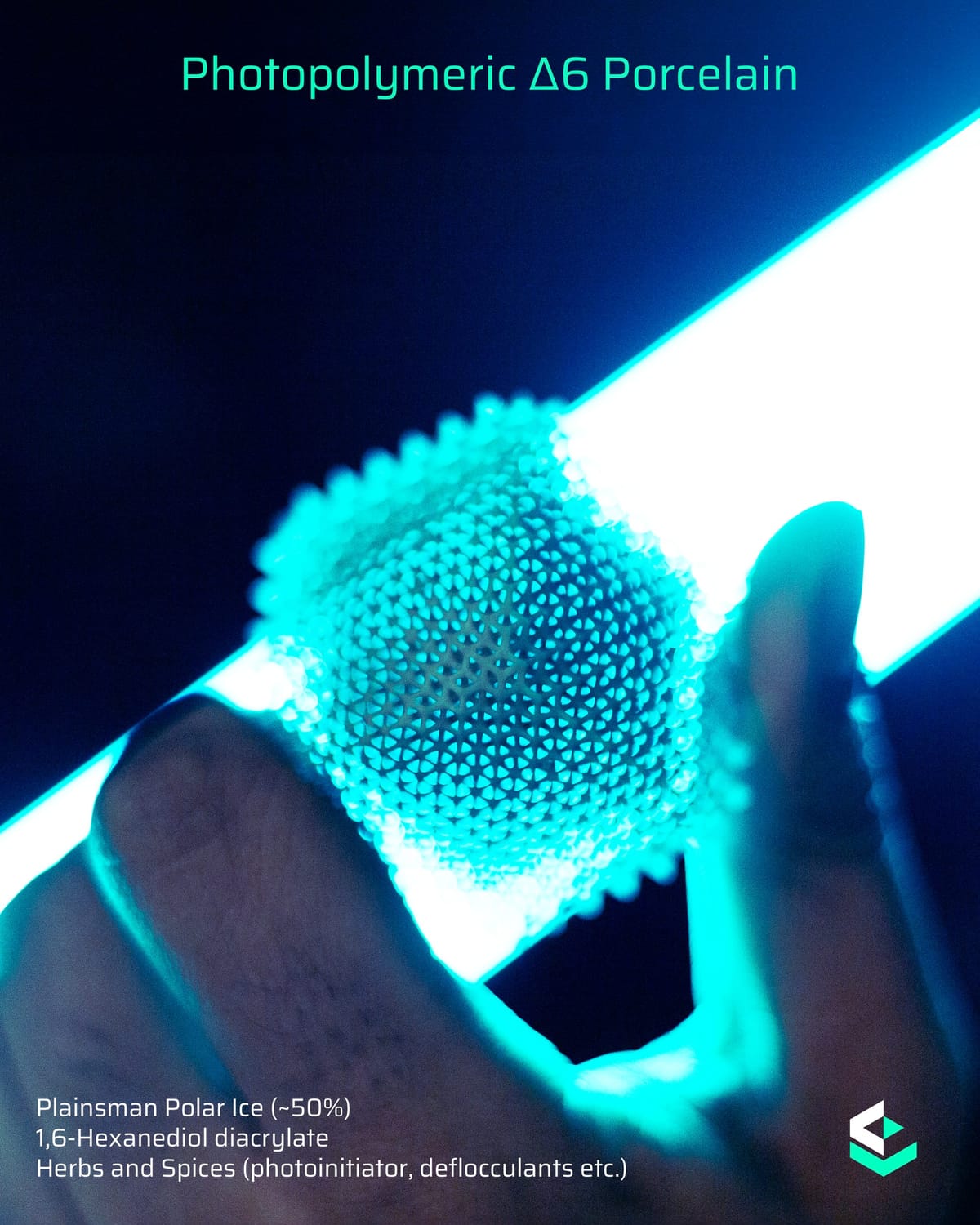
In the ever-evolving world of 3D printing, we're developing a material to revolutionize the ceramics community. Our home-brew Photopolymeric Porcelain for use in MSLA resin printers, is paving the way for extremely high-resolution ceramic 3D prints. This innovative formulation allows creators to bring complex porcelain designs to life with unprecedented precision and detail.
The journey to perfect this game-changing material has been a long one, starting back in 2021 with early experiments using off-the-shelf ingredients. Initially, the result was a thick, barely printable sludge that proved the concept's potential. However, significant challenges needed to be overcome before reaching the current stage of near-completion in R&D.
One of the primary hurdles was deflocculation – the process of preventing fine particles from clumping together. Traditional deflocculants used in slip casting, such as Darvan #7 (sodium polymethacrylate) and sodium silicate, proved ineffective for this application. The breakthrough came with the introduction of an additive that achieves deflocculation through steric stabilization, differing from the electrostatic stabilization method used by sodium polymethacrylate.
Another critical aspect of the development process was finding the right firing profile for debinding. With approximately 50% of the formulation consisting of a polymer binder, the challenge lay in burning out this binder without disturbing the ceramic particles. This process is analogous to drying traditional clay, but instead of water evaporating at room temperature, the polymer needs to be carefully burnt off in the kiln.
The potential applications for this technology are vast and exciting. When paired with generative AI, the possibilities for creating intricate, never-before-seen ceramic designs become virtually limitless. From art pieces to functional objects, photopolymeric porcelains open up a new realm of creativity in ceramic production.
Stay tuned for more updates on this exciting development in ceramic 3D printing. The future of ceramics is being reshaped, one layer at a time.